
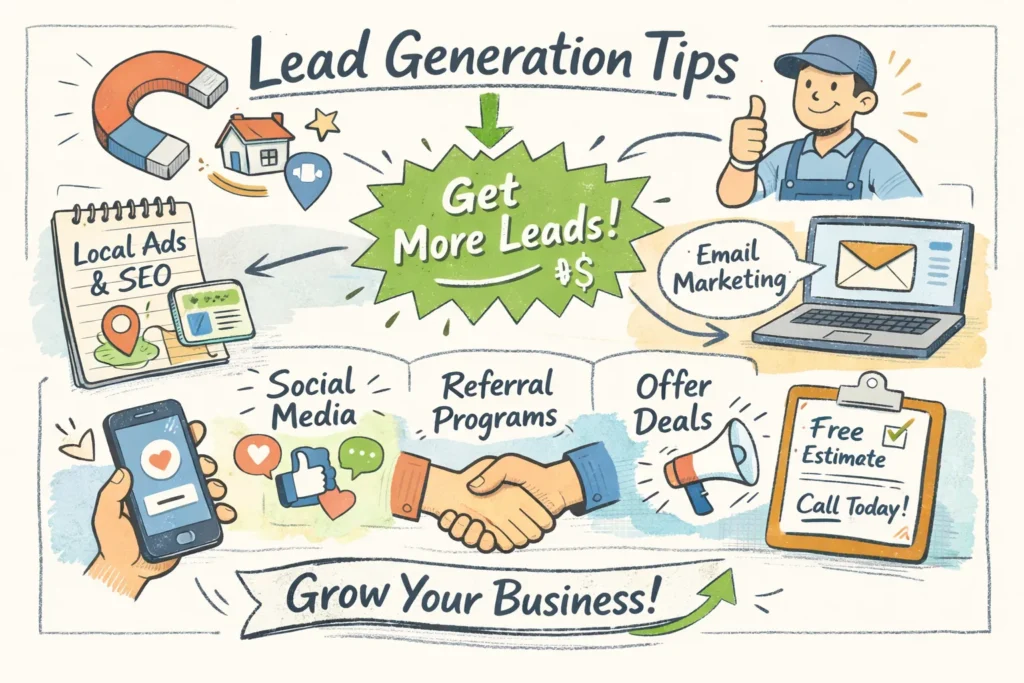
7 Lead Generation Strategies Every Home Service Contractor Needs
The referral network that once kept you busy is getting less reliable every year. Homeowners Google things now. They compare reviews. They fill out three quote forms and go with whoever responds first. If your lead generation strategy is “wait and hope,” you’re not running a business so much as running a waiting room. Implementing the best lead generation strategies for home service contractors is what separates contractors with predictable pipelines from those who ride the feast-or-famine cycle indefinitely.
This article breaks down seven proven strategies for generating residential contractor leads, with actual cost-per-lead data, realistic ROI context, and a clear sense of priority. No “post on social media” filler advice here. Just the channels that move the needle, what they cost, and why the last section might be the most important one you read.
1. Google's two-lane approach to paid contractor lead generation
Google Local Services Ads: pay-per-lead, not pay-per-click
Local Services Ads (LSAs) are the listings that appear at the very top of Google search results, above everything else including regular paid ads. You pay per verified lead (a call or message), not per click. Costs typically range from $25 to $150 per lead for most trades and markets, though competitive categories can run higher. Roofing, for instance, averages around $162 per LSA lead in many markets. For Google Search Ads and blended Google Ads campaigns, HVAC and plumbing CPLs typically run $104 to $198 based on early 2026 benchmarks, depending on category and location.
The Google Guaranteed badge displayed on LSA listings signals credibility to homeowners who are already cautious about letting strangers into their homes. For urgency-driven trades like plumbing, HVAC, and electrical, this matters most. Homeowners searching for emergency services tend to call the first credible result they see rather than spending time comparing options, and LSAs put you at the top of that list.
Google Search Ads: higher intent, higher cost
The thing that kills Google PPC performance for most contractors isn’t the bid price; it’s the landing page. Sending paid traffic to a generic homepage with no clear call-to-action is like buying a TV spot and directing viewers to your office parking lot. A dedicated service page with a specific offer consistently converts at a higher rate, and that gap directly affects your cost per acquired customer.
2. Meta ads and why home services is an underrated fit
Why Meta ads catch homeowners before they're searching
Google captures demand that already exists. Meta creates demand that doesn’t yet. A homeowner scrolling Instagram at 9pm hasn’t typed “roof replacement cost” yet, but a well-placed before/after photo of a neighbor’s new roof plants the seed. The average CPL for home improvement on Meta sits around $44.66, with most trades landing in the $40 to $100 range depending on targeting and creative quality. That’s meaningfully cheaper than Google PPC for most categories.
Before/after content, seasonal promotions, and neighborhood-level geo-targeting tend to perform well for visual trades like roofing, flooring, and landscaping, consistent with best practices for local service campaigns. Retargeting people who already visited your website is especially cost-efficient because that audience already knows who you are. You’re following up, not cold-pitching.
What makes a Meta campaign actually convert
3. Your Google Business Profile is doing less work than it should
The optimizations that actually increase calls and form fills
Documented results from fully optimized profiles are striking. Case studies show contractors seeing calls increase 56% to 178% and form submissions increase 76% to 125% after completing a full GBP optimization. That’s not from running ads. That’s from cleaning up a free profile that was already sitting there.
The review engine most contractors set up wrong
4. Lead marketplaces: the math most platforms don't show you
Angi, HomeAdvisor, Thumbtack, and similar platforms are everywhere in contractor marketing conversations. They generate real leads. But the economics are messier than the sticker price suggests, and understanding the actual math changes how you use them. A side-by-side comparison of these major lead platforms can help you pick the one that fits your trade and margin structure best: a detailed marketplace comparison.
What the platforms don't tell you about cost-per-lead
The surface-level CPL for Angi and HomeAdvisor looks reasonable: $15 to $85 per lead depending on trade. The problem is that those leads are typically shared with multiple competing contractors, often three to eight depending on the platform and market. Your real effective cost isn’t the sticker price; it’s the sticker price divided by your probability of winning the job. At a 20 to 25% win rate, your true cost-per-acquired-customer climbs to roughly $200 to $750 depending on the trade and how many competitors received the same lead.
Thumbtack shares leads less aggressively and gives contractors more control over lead selection, making it a better fit for trades where speed and qualification matter more than raw volume. Houzz performs best for larger project-based work like whole-house remodels and premium installations rather than emergency services. Responding within five minutes on any of these platforms makes you 21x more likely to convert than waiting 30 minutes, according to speed-to-lead research on service industry response rates. Speed isn’t a nice-to-have on these platforms; it’s the primary competitive variable.
When marketplaces are worth it and when they're not
5. Lead capture and follow-up: where most contractor leads go to die
The website elements that separate leads won from leads lost
Call tracking with dynamic number insertion attributes every phone lead to its source channel. Without this, you’re spending money across multiple platforms with no reliable way to know which ones are actually generating revenue versus which ones just look good on a dashboard.
Automated follow-up: the strategy most contractors don't have
The response speed data is striking. Responding to a lead within 60 seconds produces a 200% higher conversion rate. Responding within five minutes makes you 21x more likely to convert versus waiting 30 minutes. Meanwhile, research on contractor response behavior puts the average email response time at around 15 hours. That 15-hour gap is where your competitors pick up your customers.
An effective automated follow-up sequence starts with an instant SMS acknowledgment the moment a form is submitted, followed by an email with social proof within the first few minutes, and a triggered human call prompt within the first hour. Contractors who implement CRM-integrated follow-up workflows see close rates climb from around 15% to 35% and above. For deeper industry context on contractor lead behavior and follow-up best practices, see ServiceTitan’s contractor lead analysis. AI-powered follow-up handles after-hours inquiries so no lead goes cold overnight simply because your office was closed.
6. Why managing all of this separately is the real problem
The fragmented marketing setup most contractors are living with
When your ad platform, landing pages, CRM, and follow-up system operate as separate disconnected pieces, leads fall through the gaps between them. Attribution becomes impossible. You can’t tell if your Google ads are outperforming your Meta ads because neither system is tracking the same things. You spend more total money than an integrated system would cost and get less consistent results. This fragmented setup is the structural reason contractors experience unpredictable growth despite investing in marketing.
How CH Web Media's Local Reach 360 connects every strategy
The system is designed so that contractors in competitive U.S. markets can target 15 to 25 qualified leads per month without adding a second job’s worth of marketing complexity to their already full plate. In many cases, a single closed deal covers a meaningful portion of the monthly marketing investment, though results vary by trade, market, and close rate. The goal is a predictable, scalable client acquisition engine that runs while you focus on delivering excellent work.
Building a system that doesn't depend on luck
Every strategy covered here works. These are among the best lead generation strategies for home service contractors operating in competitive local markets today. Google LSAs generate high-intent leads, with costs ranging from $25 to over $150 depending on trade and market conditions. Meta ads produce volume at $40 to $100 CPL for most home service categories. A fully optimized Google Business Profile generates free inbound calls with documented increases of 56% to 178%. CRO improvements can lift lead capture rates 40 to 60%. Automated follow-up can take close rates from 15% to 35% or higher. For recent benchmark data on average cost-per-lead levels in the home improvement space, see this average cost-per-lead report for home improvement contractors. These figures reflect real campaign benchmarks, though individual results depend on market, trade, and execution quality.
The contractors who win aren’t the ones who try all seven strategies simultaneously with separate vendors and hope the pieces eventually click. They’re the ones who build these strategies into a connected system where every channel reinforces every other channel, follow-up is automatic, and the data tells a coherent story. If building that yourself sounds exhausting, you’re reading the situation correctly. An integrated approach like Local Reach 360 exists precisely because running these channels in isolation costs more and delivers less.
The contractors still waiting on referrals to come back are going to keep waiting. Those who commit to the best lead generation strategies for home service contractors and tie them into a real system this year will look back at 2025 as the year everything changed. That gap is widening every month. The good news is you already know what’s in the system.

A Complete Done-For-You System to Attract Clients and Scale Your Business on Autopilot
Get In Touch
San Jose CA, 95125
408-703-1512
info@myproject100.com
Operating Hours
Monday-Saturday: 8AM-5PM

Join Business Network
This isn’t just networking. It’s about sharing your story, finding support, and discovering opportunities with real people who believe in purpose over competition.