
Why Piecing Together Freelancers for Marketing Backfires
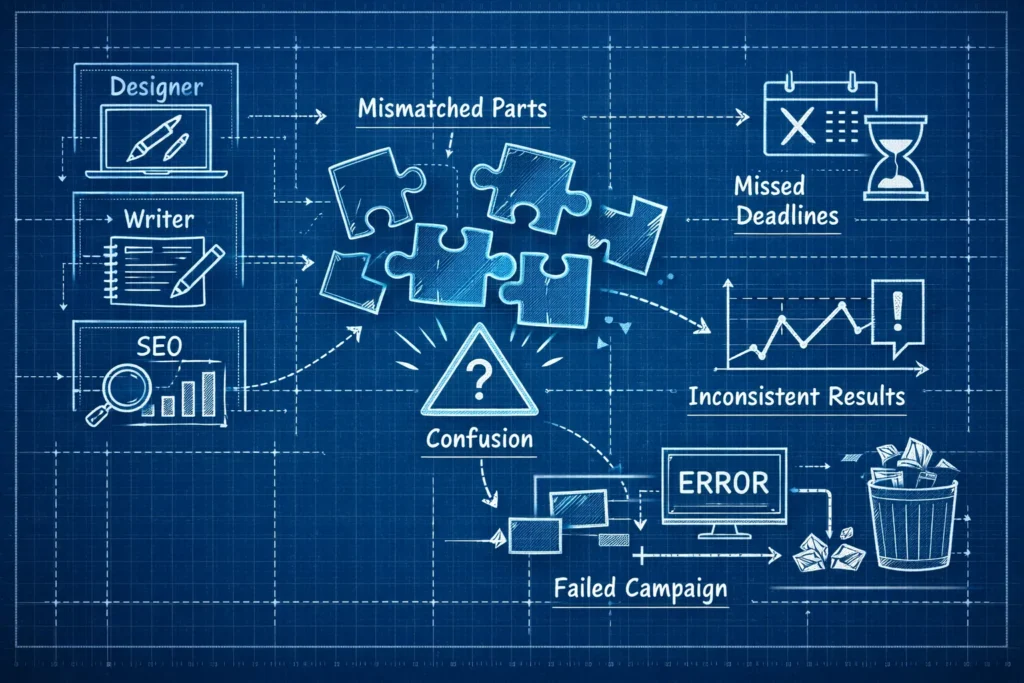
What you’ve actually built is what we call the Frankenstein system. Each piece looks functional in isolation. The copywriter is talented. The ads manager knows his way around a campaign. The designer has a beautiful eye. But the moment you need these parts to work together as a functioning, unified marketing operation, something goes wrong. Actually, several things go wrong. And the real danger is that most business owners don’t discover the extent of the damage until they’ve already wasted months and thousands of dollars.
This article isn’t a lecture about why freelancers are bad. Many are excellent. The problem isn’t the people. It’s the structure. Piecing together a fragmented freelance marketing team carries operational, financial, and legal risks that never appear on any invoice but show up in missed revenue, degraded campaigns, and legal exposure that builds quietly in the background. Every risk covered below follows a pattern, and that pattern has a name.
The patchwork freelance marketing trap: why it seems smart until it isn't
The cracks appear fast, and they appear in the gaps between people, not within them. Nobody schedules a kickoff call between the ads manager and the copywriter. The social media person is running on a brand voice document from two years ago that nobody updated. The web designer is waiting on copy that the copywriter is waiting on a brief for that the business owner hasn’t had time to write. These aren’t individual freelancer failures. They are structural failures baked into vendor fragmentation from the start. You hired five people to fill five roles and forgot that someone needs to manage the space between the roles.
Communication gaps that quietly kill campaigns when you assemble freelancers for marketing
When five freelancers work from five different tools, inboxes, and mental models of the project, the campaign strategy has no single source of truth. It exists as a loose collection of Slack messages, email threads, and shared docs that nobody fully controls or updates, creating the documentation and visibility gaps that plague distributed teams. Industry practitioners widely recommend a 10, 15% budget contingency when managing distributed freelance teams, specifically to absorb the scope changes that occur when misalignments go undetected until they become expensive (see effective budget management practices for freelancers). That’s not a line item you budgeted for when you calculated how affordable the freelance approach would be.
Where miscommunication turns into real campaign damage
The accountability black hole at the center of a patchwork freelance setup
The performance data here is worth sitting with. Research from project management studies indicates that misaligned or vacant key roles reduce project performance by as much as 76% compared to fully integrated teams. That’s not a marginal drag on results, that’s a campaign operating at a fraction of its potential because the people executing it aren’t actually connected to each other in any meaningful way.
The accountability gap compounds when a freelancer exits mid-campaign, which happens more often than most business owners expect. Freelancers land bigger clients, get overbooked, or simply move on. When they leave, they take institutional knowledge with them: the ad account history, the brand voice understanding built over months, the conversion insights that were never documented anywhere. The replacement costs are real. The ramp-up period while live campaigns degrade is real. And the continuity loss is the kind of outsourced marketing pitfall that nobody lists in the job posting.
Inconsistent branding and ad spend that burns without a unified strategy
Where wasted ad spend hides in a fragmented setup
The most financially painful version of this problem shows up in paid advertising. When an ads manager isn’t working in lockstep with the copywriter, funnel builder, and CRM setup, the ad campaign becomes a standalone tactic disconnected from the full customer journey. Industry benchmarks suggest businesses can waste 20, 30% of their ad budgets through poor targeting and lack of cross-channel optimization, and that figure climbs further when the person running the ads has no visibility into what happens after the click. Budget gets spent driving traffic to a funnel that wasn’t built to convert it. Retargeting audiences overlap because nobody mapped the targeting logic end-to-end. Feedback loops between ad performance and offer messaging don’t exist because the two people who could act on that data have never been on a call together. For more on the hidden costs behind inefficient ad spend, see this analysis of the hidden cost of wasted ad spend.
The legal and financial exposure most business owners never see coming
U.S. copyright law creates an exposure that catches many business owners off guard. Freelancers retain ownership of their work by default unless a written contract explicitly transfers those rights. Small businesses hiring through referrals or gig platforms frequently skip this step, leaving the IP ownership question unresolved. The ad creatives, landing page copy, and brand assets you paid for may not legally belong to you. What happens when a freelancer used a licensed stock photo you can’t trace? What happens when they repurpose your brand assets for another client because no non-use clause existed in your agreement? These aren’t hypothetical scenarios. They’re common ones, and they create real exposure. A practical legal guide for hiring freelancers and independent contractors outlines contract clauses that help transfer IP and reduce that risk.
Misclassification risk and data privacy exposure
Worker misclassification adds another layer of risk worth understanding separately. The IRS and the Department of Labor both apply specific tests to determine whether someone is genuinely an independent contractor or functions more like an employee. Businesses that exercise significant control over a freelancer’s work process, assign ongoing core business functions, or integrate freelancers deeply into daily operations can face misclassification liability even when both parties agreed to a contractor arrangement. Federal penalties under the FLSA can reach $1,000 per violation, and enforcement actions in states like California have resulted in total penalties exceeding $2.3 million against a single employer. Beyond misclassification, any freelancer handling customer data without an NDA or compliant data practices exposes the business to privacy liability. None of this gets discovered until someone files a complaint or an audit begins.
What an integrated system actually changes
This is exactly what drives the architecture behind CH Web Media’s Local Reach 360 system. Brand messaging, paid ads, automated funnels, CRM integration, and AI-powered follow-up don’t just coexist on the same dashboard, they feed each other. The ad copy is written by the same team running the ads and building the funnel. There’s no translation gap between intent and execution because there’s no gap between the people doing the work.
The value here isn’t convenience. It’s accountability. One entity owns the outcome, not just the deliverable. When the campaign underperforms, there’s no finger-pointing across vendors because there’s only one team to ask. When the brand voice needs to shift, that change propagates across every channel simultaneously because one team manages every channel. And on the financial side, the model is designed to be efficient: the monthly investment is structured around a target where a single converted lead can offset the cost, reframing the entire cost question from marketing expense to revenue engine.
The pattern has a name, and it has a fix
The businesses that break out of this cycle aren’t the ones who found better individual freelancers. They’re the ones who stopped patching and started building. If any section of this article described your current marketing setup, that’s not bad luck. It’s the predictable outcome of a fragmented approach, and it has a predictable fix. If you’re ready to replace the Frankenstein system with something built to work as a whole, CH Web Media is where that conversation starts.

A Complete Done-For-You System to Attract Clients and Scale Your Business on Autopilot
Get In Touch
San Jose CA, 95125
408-703-1512
info@myproject100.com
Operating Hours
Monday-Saturday: 8AM-5PM

Join Business Network
This isn’t just networking. It’s about sharing your story, finding support, and discovering opportunities with real people who believe in purpose over competition.