
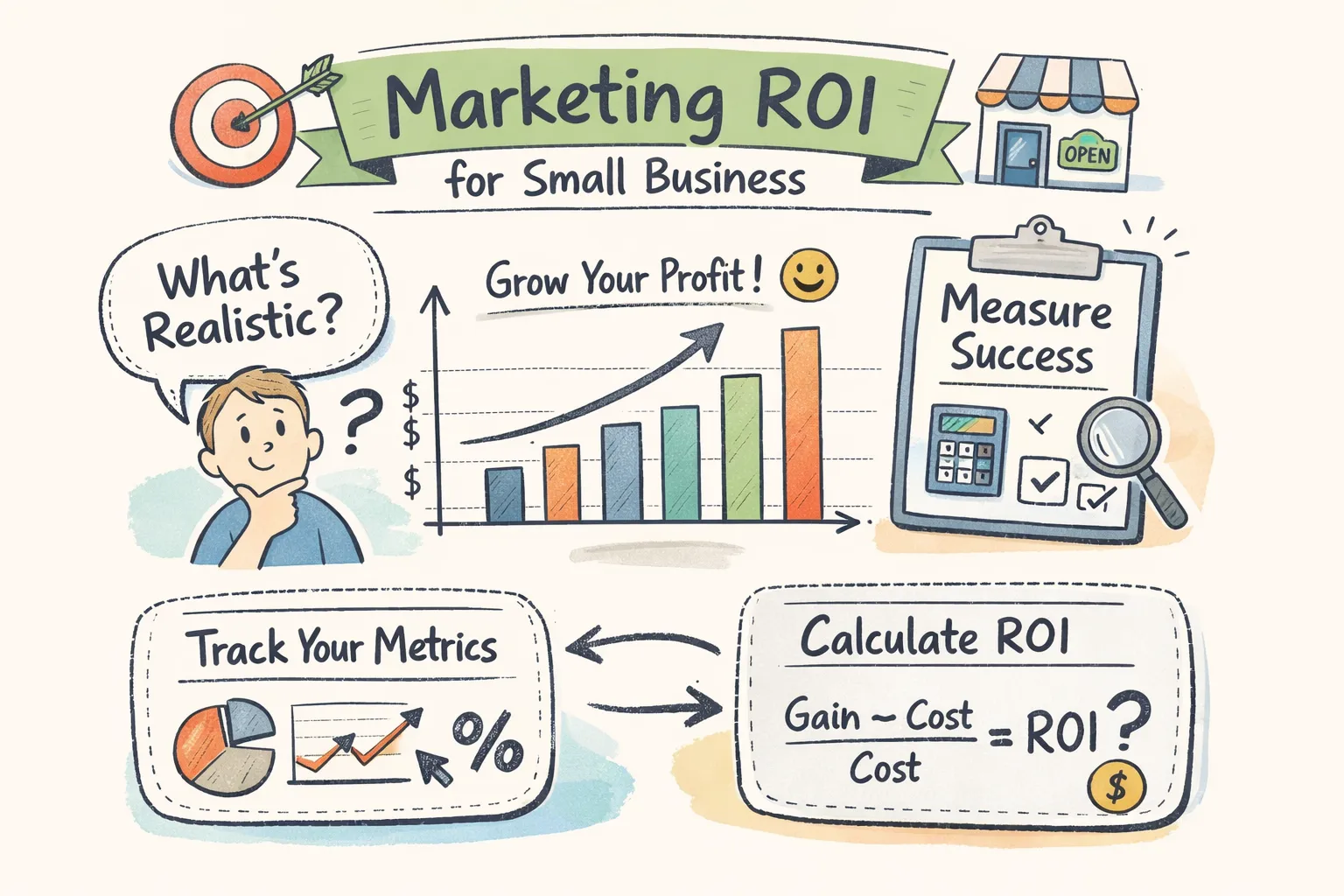
Marketing ROI for Small Business: What's Realistic and How to Measure It
This article walks through the real formula (not the simplified version that makes campaigns look better than they are), honest channel benchmarks, the five KPIs that actually connect your marketing to revenue, and a simple attribution setup you can build this week without a technical background. By the end, you’ll have a framework to calculate your marketing return and a mental model that makes every future spending decision easier.
The Formula Most Small Businesses Get Wrong
Most small business owners calculate marketing ROI by dividing revenue by ad spend. That number feels useful. It rarely is. The problem is that revenue doesn’t tell you whether you made money. A campaign that generates $30,000 in revenue from $8,000 in ad spend looks great until you remember that $15,000 of that revenue went to labor and materials. Now your “winning” campaign barely broke even.
The correct approach uses ROMI (return on marketing investment), starting with gross profit rather than gross revenue. The standard formula is: ROMI = (Gross Profit from Marketing − Marketing Cost) / Marketing Cost. Gross profit is simply your revenue minus the cost of delivering that service or product. This version gives you a real picture of whether the campaign actually put money in your pocket.
Here’s what that looks like across three common scenarios. A clothing boutique runs Facebook ads, spends $8,000, and generates $30,000 in revenue with $8,000 in product costs. Gross profit is $22,000. ROMI = ($22,000 − $8,000) / $8,000 = 175%. That’s $2.75 back for every dollar spent. A local coffee shop invests $10,000 in an email campaign, earns $40,000 in revenue with $10,000 in COGS. ROMI = ($30,000 − $10,000) / $10,000 = 200%. A bakery sends direct mail flyers for $10,500, drives $50,000 in incremental revenue with $7,000 in costs. ROMI = ($43,000 − $10,500) / $10,500 = 310%. The benchmark to know: anything above 100% means you made a profit, 500% is solid, and 1,000% is exceptional.
Realistic Marketing ROI Benchmarks for Small Businesses by Channel
Paid Channels and What's Actually Reasonable
Measuring Marketing ROI for Small Business: The KPIs That Actually Matter
The Five Metrics Worth Tracking
- Marketing ROI (ROMI): The profit-based formula from above. The profit-based number every other metric feeds into.
- Cost per Acquisition (CPA/CAC): Total marketing spend divided by new customers acquired. Example: $1,000 spent to acquire 10 customers = $100 CAC.
- Customer Lifetime Value (LTV): Total projected revenue from a customer over their relationship with your business. Home services benchmarks put this between $2,400 and $47,000 depending on the service type.
- Conversion Rate: Percentage of visitors or leads who take a desired action. Always pair this with traffic source data; never look at it in isolation.
- Website Traffic by Source: Useful only when segmented by channel. Total traffic is a vanity metric; traffic by source tells you what’s actually working.
The LTV-to-CAC Ratio: The Number That Tells You If Your Marketing Is Sustainable
The LTV-to-CAC Ratio: The Number That Tells You If Your Marketing Is Sustainable
High-Intent Channels: Where Local Buyers Are Already Searching
Your restaurant’s success story starts with the right marketing strategies. Don’t wait to elevate your approach and reach new heights in the industry!
How an Integrated System Structures the Channel Mix for Service Clients
One approach that works well for service businesses is combining Google and Meta ads with automated funnels and follow-up sequences under one integrated system, specifically because disconnected tactics waste budget at the handoff points between channels. CH Web Media structures its Local Reach 360 system around this principle, with a straightforward internal benchmark: one closed deal should cover the entire month’s marketing cost. For a roofer with a $7,000 average job or a mortgage broker earning $3,500 per closed loan, that threshold is illustrative of how quickly high-ticket service businesses can reach self-funding status. Once marketing is self-funding, every additional lead contributes directly to margin growth, a very different experience than watching ad spend disappear with no clear return.
A Simple Attribution Setup That Won't Overwhelm You
Attribution is where most small business owners check out. It sounds like something that requires a data science team, a custom dashboard, and a budget most small businesses don’t have. The reality is that two free tools, set up correctly, give you most of the clarity you need to make good channel decisions, and if you want to explore more complex options, this list of top marketing attribution tools can help you evaluate what to add next.
GA4 and UTM Parameters: The Foundation of Honest Attribution
Google Analytics 4 is free and tracks traffic sources, conversion events, and basic multi-touch attribution out of the box. UTM parameters are the mechanism that feeds it accurate data. Think of them as labels you attach to every link you share, so GA4 knows whether a visitor came from your Facebook ad, your email newsletter, or a Google search. The setup is three fields: utm_source (where, like “facebook” or “google”), utm_medium (the type, like “paid_social” or “email”), and utm_campaign (which specific campaign). Use a free UTM builder, standardize your naming with lowercase and underscores, and never add UTMs to internal links on your own site. That last mistake is more common than it should be and quietly corrupts your attribution data. For a practical walkthrough, see this guide to UTM tracking in GA4.
Connecting Your Tracking to Actual Revenue: Basic CRM Integration
The One Benchmark That Should Anchor Your Entire Marketing Budget
For local service businesses, this benchmark is achievable with a well-structured system. A roofer closing one $7,000 job covers a typical month of marketing spend. A mortgage broker closing one loan can cover two months. A pest control company signing one annual contract covers several weeks. These are illustrative examples, actual breakeven depends on your specific marketing budget, but they reflect how favorably the math works for high-ticket service businesses. Most service business owners never consciously run these numbers, which is why they consistently underinvest in marketing even when the returns strongly favor spending more. The businesses that grow predictably are the ones that understand this threshold and build a system designed to clear it reliably every month.
Where to Go From Here

A Complete Done-For-You System to Attract Clients and Scale Your Business on Autopilot
Get In Touch
San Jose CA, 95125
408-703-1512
info@myproject100.com
Operating Hours
Monday-Saturday: 8AM-5PM

Join Business Network
This isn’t just networking. It’s about sharing your story, finding support, and discovering opportunities with real people who believe in purpose over competition.