
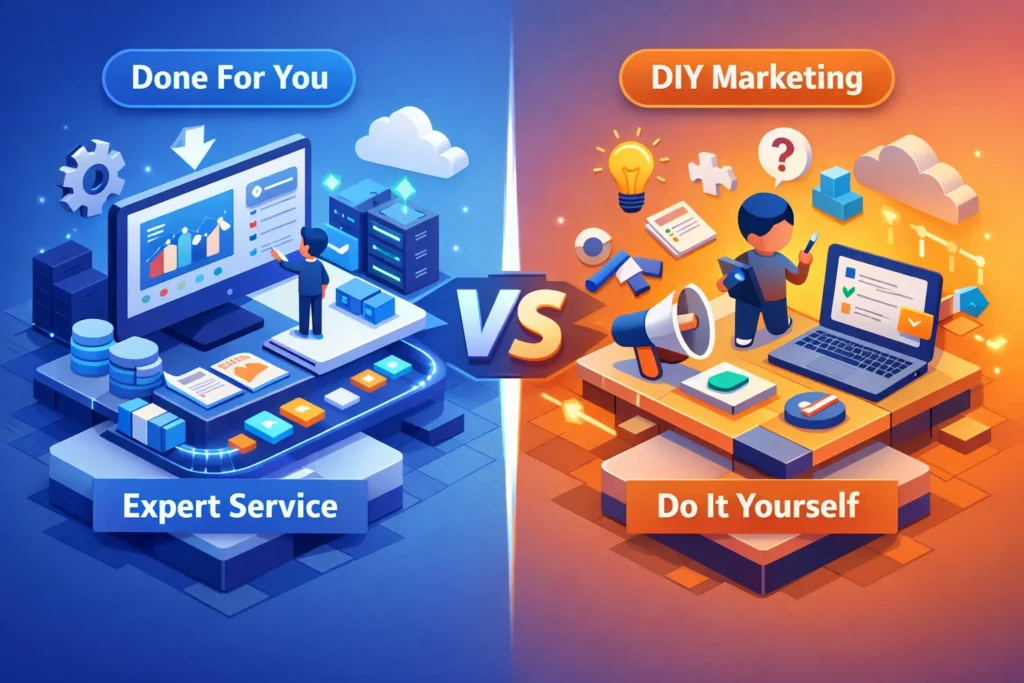
Done For You System vs DIY Marketing: Which Wins?
There’s a meaningful difference between a real done for you system and the patchwork of vendors most business owners mistake for one. The confusion is understandable because the marketing industry has thoroughly mangled the phrase “done for you”, vendors apply it inconsistently to templates, half-built funnels, and coaching programs where you do 80% of the work. So let’s actually define what a true end-to-end system looks like, what it costs, what returns it can generate, and, critically, how to evaluate any offer before you sign anything.
This is the framework CH Web Media built their entire Local Reach 360 model around: the recognition that most service businesses aren’t failing at marketing because they lack effort. They’re failing because the components they’ve assembled don’t actually work together. By the end of this article, you’ll know exactly how to tell the difference.
What a done for you system actually means
Beyond the buzzword: a real working definition
A genuine done for you system is a fully managed, end-to-end service where the provider builds, implements, and maintains the entire solution. Your involvement after onboarding should be minimal. You review results, approve major creative decisions, and show up to close deals. That’s it. The provider holds execution responsibility for everything else, continuously, not just during setup.
This is categorically different from what most vendors sell when they use the phrase. A “done-for-you funnel system” that gets handed over as a ClickFunnels template you still have to connect, populate, and manage is not a done for you system. It’s a head start. The critical test is simple: after onboarding, who is responsible for making sure the system works next month?
DFY vs. done-with-you vs. DIY: the three-lane highway
DIY works if you have time, technical ability, and patience for a steep learning curve. Done-with-you works if you want to eventually own the skills yourself. But for a service business owner who’s already maxed out running their actual service, those first two lanes just add more to the plate. Only the third lane solves the real problem, which isn’t a lack of tools. It’s a lack of capacity to run them.
What's actually inside a full-stack done for you system
The components that have to work together
A genuine managed marketing service includes brand clarity and positioning, paid ad campaigns on Google and Meta, landing pages and automated sales funnels, CRM integration, AI-powered lead follow-up sequences, and performance reporting. That’s the full stack. (Many true turnkey providers also offer dedicated done-for-you lead generation services as a core capability.) But here’s the part most vendors gloss over: having all these pieces isn’t the same as having a system. A system means they’re designed to work as a connected pipeline.
A lead captured through a Google ad needs to immediately enter a CRM, trigger an automated follow-up sequence as quickly as possible, and route to a human when it’s warm enough to close. If any of those handoffs require manual action, or if a gap exists between components, that’s where leads die. The architecture matters as much as the individual parts.
The integration problem most DFY vendors ignore
Every gap between components is a place where leads and money quietly disappear. Every handoff in that chain, ad to landing page, landing page to CRM, CRM to follow-up, follow-up to close, is a leak point. True turnkey marketing systems eliminate those gaps by owning the full pipeline under one accountable team. That ownership distinction is everything.
The piecemeal freelancer trap: why DIY coordination quietly kills results
The "Frankenstein" marketing setup problem
The hidden cost here isn’t just frustration. It’s the time you spend playing project manager: briefing multiple vendors on the same campaign goals, reconciling conflicting strategic advice, chasing deliverables across five different email threads, and manually connecting systems that were never designed to talk to each other. That coordination overhead is a real business cost, and it compounds every month.
What disconnected systems cost beyond the invoices
The comparison is sharper when you run the full numbers. Hiring separate freelancers for ads, CRM, funnels, and branding can reach $6,000 to $34,000 per month at full execution capacity, with an additional 10 to 25 percent coordination overhead on top. For perspective on the trade-offs between outsourcing CRM work and doing it yourself, see discussions about CRM cost vs doing it yourself. An integrated managed marketing service covering the same functions, including outsourced automation services and full pipeline ownership, typically runs $3,500 to $7,000 per month. One system, one team, one number to hold accountable. The economics aren’t even close once you factor in the coordination costs that freelancers never invoice you for.
Realistic expectations: pricing, timelines, and what real ROI looks like
What DFY marketing actually costs across tiers
The quality gaps at cheaper tiers tend to appear in the same places: no real CRM integration, weak or absent follow-up automation, and brand messaging that was never properly developed. These aren’t add-ons. They’re the components that determine whether a lead converts or goes cold. Paying $2,000 per month for ads with no functioning follow-up system is like paying for a fishing net with holes in it.
ROI benchmarks and how to think about payback period
The simplest way to think about payback period for any service business is this: if a single closed client from the system covers the entire monthly fee, the system is self-funding from the first conversion. For a roofer, a plumber, or a mortgage broker where one closed deal can be worth $5,000 to $20,000, that math works very quickly. Most providers can generate measurable leads within 30 to 60 days of launch, with actual conversions typically occurring within the first three months of a campaign going live.
Local Reach 360: what a real done for you system looks like in practice
How CH Web Media built an end-to-end growth engine
The follow-up layer uses AI-powered automation to ensure no lead goes cold between the moment of inquiry and the moment of close. That’s the piece most agencies skip entirely, and it’s where the majority of leads die in piecemeal setups. Local Reach 360 includes closing support so that when a qualified lead is ready to talk, the client has the tools and guidance to convert that conversation into revenue. Every component hands off to the next without requiring the business owner to manually bridge the gap.
Why one roof changes everything for service businesses
CH Web Media’s model is built around a straightforward economic argument: for most service businesses, a single closed deal covers the month’s marketing cost. For businesses that have tried piecing together freelancers and gotten burned, this isn’t just a convenience. It’s a fundamentally different risk profile. The system is designed to be self-funding from the first conversion, which shifts the conversation from “can we afford this?” to “how quickly does it pay for itself?”
How to evaluate any DFY offer before you sign
Red flags that reveal a weak done for you system
The warning signs of a weak DFY offer are consistent across providers. Watch for vague deliverable lists that describe outcomes without specifying what gets built. Watch for no documented onboarding process, which usually signals the “system” is improvised per client. Pay close attention to ownership language: verify in the contract that you own your ad accounts, CRM data, and funnel assets outright, and negotiate transfer terms before signing if any clause is ambiguous.
Months-long “setup and strategy” phases that delay real work by 60 to 90 days are another signal. Good marketing doesn’t require six months of planning. You should see initial campaign activity within the first month, not the first quarter. Also review auto-renewal clauses, exit conditions, and what happens to assets at cancellation. Standard contracts include 30-day written cancellation notice after an initial term of 90 days, with liability for payments during the notice period. Any contract that locks you into 12 months without flexibility should prompt serious questions. For an accessible primer on what done-for-you digital marketing really means for small businesses, consult industry analyses that contrast head-start offers with true managed services.
7 questions to ask before buying any DFY marketing system
- What exact deliverables are completed in month one? You want specifics: ad campaigns live, funnel pages built, CRM configured, follow-up sequences active. Vague answers mean vague execution.
- Who owns the ad accounts, CRM, and funnel assets if I leave? These should be yours from day one, not held by the provider as leverage.
- What is the minimum contract term and what are the exit conditions? Understand what you’re committing to and what cancellation actually requires.
- How is performance measured and reported? Look for metrics tied to business outcomes (leads, conversions, revenue), not vanity metrics like impressions and follower counts.
- Who is my point of contact and how are they reachable? Some contracts cap communication at two calls per month. Know what you’re getting before you need it.
- What happens when leads come in? Does your system handle follow-up, or do I? Any answer that puts follow-up responsibility back on you means it’s not a done for you system.
- Can you show me a case study from a business in my industry? Benchmark data, conversion rates, revenue results, timeline. If a provider struggles to answer clearly, that is itself an answer about how the engagement will go.
The structural difference that actually determines results
When the system is scattered across vendors with misaligned incentives, the gaps eat your results. The ads agency optimizes for click-through rate. The funnel builder optimizes for page load speed. The VA optimizes for emails sent. Nobody optimizes for closed clients, because nobody owns the full pipeline. That’s the Frankenstein problem in its final form: impressive parts, no coherent organism.
Apply the 7 questions above to any DFY offer you’re evaluating. The answers will surface fast whether you’re looking at a real integrated system or an expensive collection of parts. If you’re a service-based business owner who’s done the freelancer experiment and is ready to stop coordinating vendors and start running a real client acquisition engine, a true done for you system is the answer, and CH Web Media’s Local Reach 360 is built for exactly that transition. One pipeline, one partner, one number to hold accountable.

A Complete Done-For-You System to Attract Clients and Scale Your Business on Autopilot
Get In Touch
San Jose CA, 95125
408-703-1512
info@myproject100.com
Operating Hours
Monday-Saturday: 8AM-5PM

Join Business Network
This isn’t just networking. It’s about sharing your story, finding support, and discovering opportunities with real people who believe in purpose over competition.