
Why Local Service Businesses Struggle to Get Clients (And the Fix)
Picture this. You open the best barbershop in the city. Your cuts are flawless. Your customer service is legendary. Your pricing is fair. But the building has no sign, no windows, and the front door is locked from the outside. Nobody walks by and thinks, “I bet there’s an incredible barber in there.” They just walk past.
This is the situation most skilled tradespeople and service professionals find themselves in, not because they’re bad at their work, but because they lack a system that keeps new clients showing up consistently. If you’ve been searching for how to get more clients for your local service business, the answer isn’t working harder at your craft. It’s building a separate engine that fills your calendar while you’re out on the job. This article walks through the three layers of that engine: Google presence, paid ads, and automated follow-up. For business owners who’d rather have someone build that engine for them, CH Web Media exists for exactly that purpose. But first, the diagnosis.
Why most service businesses are stuck in feast-or-famine mode
The referral trap: why word-of-mouth isn't a strategy
The feast-or-famine cycle is exhausting, too much work one month, too little the next, and it almost always roots back to this trap. Consider a fencing company that spent years generating 2-3 leads per month entirely through referrals. After building an active local presence with consistent review generation and content, they reached 40+ qualified leads per month within six months. The work didn’t get better. The visibility did.
The "Frankenstein" marketing problem
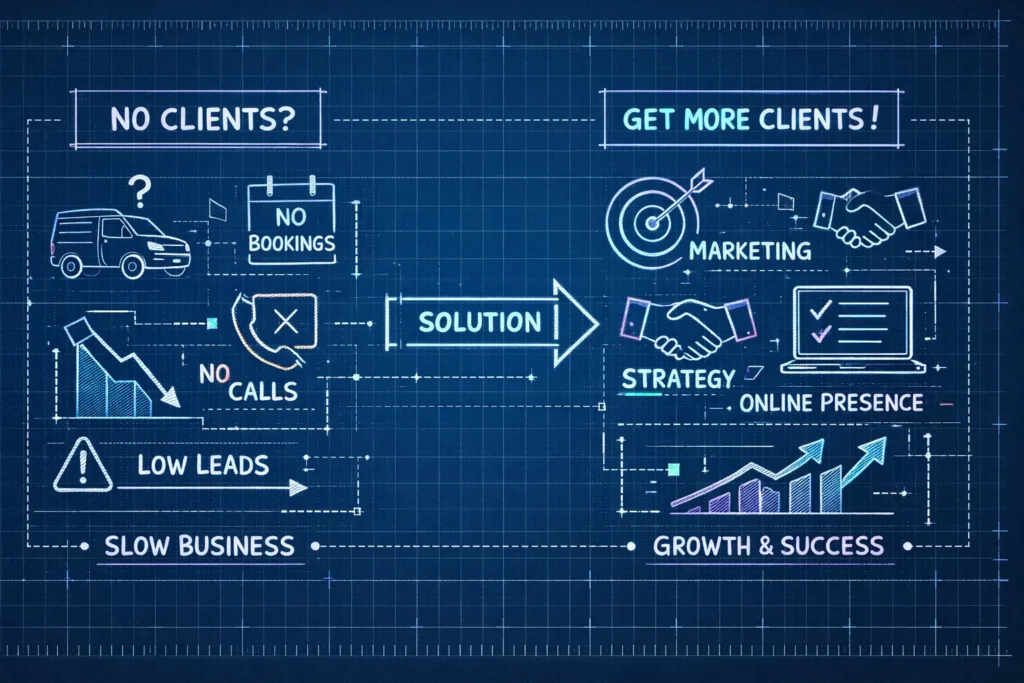
The real fix isn’t more channels. It’s an integrated client acquisition system with specific components working together: visibility that puts you in front of buyers actively searching, paid reach that generates leads immediately, and follow-up infrastructure that converts those leads before they go cold. Here’s how to build each layer.
How to get more clients for your local service business: build a Google presence first
Optimize your Google Business Profile for maximum local visibility
Before spending a single dollar on ads, you need to own your Google real estate. Your Google Business Profile (GBP) is the single highest-leverage free tool available to any local service business. The numbers here are striking: according to GBP performance studies, businesses with 100+ geotagged photos see 520% more calls and over 2,700% more direction requests compared to skeleton listings with minimal photos. That’s the difference between a fully built-out profile and one with a single stock photo and an address.
The highest-impact moves, in order: upload geotagged photos regularly, nail your primary and secondary category selections, keep your name, address, and phone number (NAP) consistent everywhere, and post updates with service keywords at least weekly. Respond to every Q&A on your profile. These actions directly signal relevance, popularity, and engagement to Google’s local ranking algorithm. Visible ranking gains in Google Maps can appear within 7-14 days when these optimizations are done properly, though timelines depend on your market’s competition level and how consistently you maintain the profile. For a practical Google Business Profile optimization checklist, see Merchynt’s guide.
Build your review engine with a repeatable ask system
The process has two steps and takes less than a weekend to set up. Within 24-48 hours of completing a job, identify satisfied customers and send a personalized SMS or email with a direct link to your Google review page. If there’s no response, follow up once at day 3-5. Here’s a template that works:
SMS: “Hi [Name], thanks for letting us handle [service] for you! If you have 60 seconds, a quick Google review would mean the world to us: [Link]. Reply STOP to opt out.
“Email subject: “Thanks [Name], quick favor?”, with a two-sentence body: thank them, provide the link, keep it under 100 words total. Brevity matters here; a short, specific ask outperforms a long explanation every time. Track two KPIs: review velocity (new reviews per week) and your average star rating trend over 30-day windows. For data-driven tactics on collecting and leveraging customer reviews, see Supermetrics’ analysis of customer review impact and best practices.
Local citations and service pages for sustained authority
Step 2: Use paid ads to generate leads while your organic presence builds
Local Services Ads vs. Google Search Ads: which one wins for home services
Organic visibility takes time. Paid ads fill the gap. For established home service categories like plumbing, roofing, HVAC, and pest control, Local Services Ads (LSAs) are currently the most cost-efficient paid option available. Industry data shows LSAs averaging around $60 per lead versus $70+ for standard Google Search Ads, and critically, you pay only for valid leads, not clicks. The Google Guaranteed badge that comes with LSA approval drives 29% click preference from consumers compared to 11% for standard search ads, a meaningful trust differential that directly affects how often potential clients choose you over a competitor (see Local Services Ads statistics).
LSA approval timelines vary by region and how quickly you complete business verification and background check documentation, but leads can start flowing soon after approval. A reasonable monthly budget for meaningful lead volume in most markets falls between $500 and $1,500, though this varies by market size and service category. For services that don’t yet have an LSA category, standard Google Search Ads targeting high-intent queries (“emergency plumber [city]”) are the next best option. One plumbing company rebuilt their campaign around exactly this approach, focusing exclusively on emergency-intent keywords, and saw 99% conversion growth in 30 days while cutting cost-per-acquisition by 67%.
Meta ads for local reach on a smaller budget
Step 3: Build a follow-up system that converts leads into paying clients
Why most leads go cold, and what it actually costs you
Run the math on your own average job value. If your average project is worth $1,500 and you’re converting 25% of leads when a faster follow-up system could push that to 35%, every 40-lead month where you’re under-converting represents roughly $6,000 in unrealized revenue. That’s not a marketing problem. It’s a systems problem.
Set up a simple CRM and automated follow-up sequence
The specific CRM matters less than the structure. Platforms like HubSpot (free tier), Zoho, and field-service-specific tools like Jobber or Housecall Pro all support this workflow. The rule is simple: no lead goes untouched for more than 24 hours. Track lead response time and lead-to-booked-call conversion rate weekly, both numbers tell you where the system is leaking before it becomes a revenue problem.
Using AI-powered follow-up to handle volume without hiring
How to prioritize, budget, and know if your system is working
Pick your first tactics and estimate realistic costs
Budget ranges by stage, as illustrative benchmarks:
- Organic-only (GBP, reviews, citations): $0-$500/month in time and tools
- Ads plus basic CRM system: $500-$1,500/monthFull integrated setup with ads, automation, and AI follow-up: $1,500-$3,000/month
These ranges reflect typical spend patterns for service businesses at each growth stage, not fixed industry standards, your market, service category, and competitive landscape will affect actual costs.
The KPIs that tell you your client acquisition system is healthy
- GBP profile views and call volume (trend direction matters more than absolute numbers)
- Review velocity: new reviews per weekCost per lead from paid ads (industry data suggests an average LSA CPL around $60, use that as a reference point, adjusted for your market and category)
- Lead response time (target under 5 minutes; under 60 seconds is elite)
- Lead-to-booked-call conversion rate (track your own baseline and aim for consistent improvement week over week)
- Close rate on booked calls (benchmark varies by service type, track your own trend)
If any of these numbers are moving in the wrong direction, you know exactly which layer to investigate rather than guessing at the whole system.
The fastest path to a full client pipeline without building it yourself
What an integrated done-for-you system actually looks like
Local Reach 360 is a fully integrated client acquisition engine combining brand messaging, Google and Meta ad campaigns, automated funnels, CRM, and AI-powered follow-up under one roof. Every component is designed to work together from day one, not stitched together from separate vendors with separate logins and separate reports. Based on client results, the system is designed so that a single closed deal typically offsets the monthly investment: one roof for a roofing company, one funded loan for a mortgage broker. That’s the benchmark CH Web Media builds toward, not a guarantee, but a clear and measurable target.
Who this approach is (and isn't) built for
Now you know how to get more clients for your local service business, here's what to do next
The problem was never the quality of the service. It was the invisible building with the locked front door. Getting more local clients consistently requires three things working together: a Google presence that puts you on the map, paid ads that generate leads while you’re working, and a follow-up system that converts those leads before they go cold.Pick one layer to start this week. If you have nothing, start with your Google Business Profile. If you have a GBP, build your review engine. If you have both, set up your first CRM workflow. Each layer compounds on the one before it, and the business that has all three running stops operating on luck and starts operating on a system.Now you have a clear picture of how to get more clients for a local service business, start with one piece, build toward all three, and measure everything along the way. For business owners who want the entire engine built and running without doing it themselves, CH Web Media’s Local Reach 360 is worth a closer look. Predictable growth isn’t a lucky streak. It’s what happens when the right systems are in place and every piece is finally talking to every other piece.