Done-for-You Med Spa Funnel: From Ad Click to Booked
If you’re evaluating a done for you funnel for med spa growth, here’s the uncomfortable truth: your ads probably aren’t the problem. Picture this, you’re a med spa owner running Facebook ads, watching engagement metrics climb, then looking at your booking calendar. Half-empty. Maybe worse. Your treatments are excellent, your staff is great, and your pricing is competitive. So what’s going wrong?
The ad is doing its job. The problem is everything that happens after the click. Someone taps your ad, lands somewhere, gets a little interested, then gets distracted by a push notification, forgets to call back, and books with your competitor three days later because they got a follow-up text first. That gap between “someone saw your ad” and “someone confirmed an appointment” is where most med spas lose revenue silently, every single month. Industry data on digital lead funnels consistently shows that the majority of conversion drop-off happens not at the ad level, but between the initial click and the confirmed booking.
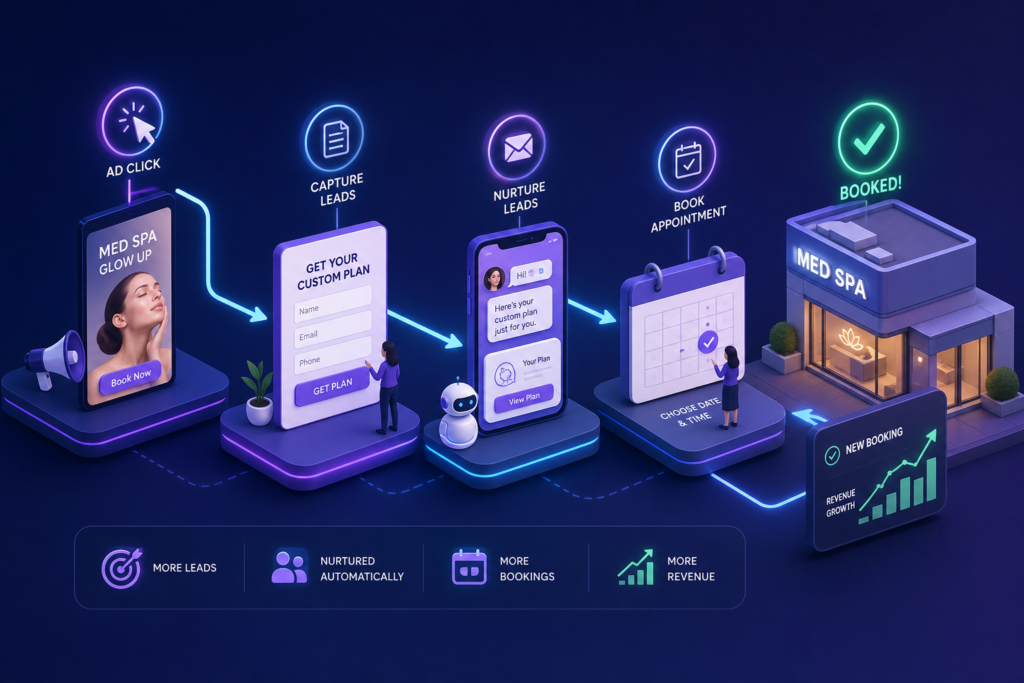
A done for you funnel for med spa practices closes that gap automatically. It handles every step: capturing the lead, warming them up, making booking frictionless, and keeping patients coming back. CH Web Media built their Local Reach 360 system around exactly this kind of connected, end-to-end approach for service businesses. What follows is a stage-by-stage breakdown of how these funnels work, what they cost, and what results you can realistically expect, so you can decide whether this is the right move for your practice.
What a done-for-you med spa funnel actually includes
The five components every complete funnel needs
- Targeted paid ads that surface your offer to the right people in your local area
- A lead capture mechanism (a high-converting landing page or an interactive quiz) that exchanges something valuable for the visitor’s contact information
- An automated nurture sequence using email and SMS that educates, builds trust, and moves the lead toward a decision
- A frictionless booking flow where a warm lead can confirm an appointment in under two minutesA post-visit follow-up system that drives rebooking, requests reviews, and reactivates leads who went cold
The "Frankenstein problem" with cobbling tools together
Most med spas already have pieces of this system. A Facebook ad here. A landing page builder there. A booking tool set up six months ago that doesn’t talk to their email platform. A CRM they’re technically subscribed to but haven’t opened in weeks. The result is what you might call the Frankenstein funnel: technically alive, but lurching around unpredictably.
When tools aren’t integrated, leads fall through the cracks between them. Someone opts in on your landing page, but that data doesn’t automatically feed into your email sequence, so they never receive the nurture flow. Or they get the emails but the booking link goes to a page that loads slowly on mobile, and they bounce. Research into med spa lead flows suggests that integration failures account for a significant share of the drop-off between opt-in and scheduled appointment. A properly built medspa lead generation funnel connects every stage so data flows automatically and no lead gets lost in the handoff. That integration is the whole point. Industry resources on med spa marketing strategies also highlight these common failure points and practical fixes.
Stage one: Capturing the right leads with targeted ads and a smart offer
Which ad platforms work best for med spas
Cost per lead on Meta ranges from $4 to around $50 depending on the treatment, the creative, and how competitive your local market is. One documented example from a 90-day Botox campaign produced CPLs as low as $4.23 across 763 leads, and it’s worth noting that results at that end of the range reflect highly optimized targeting, strong creative, and a proven offer. Most well-run campaigns land somewhere in the middle of that range.
Lead magnets that pre-qualify before the opt-in
The best-performing lead magnets for med spas aren’t generic discounts like “10% off your first visit.” Personalized skin quizzes, free consultation offers tied to a specific treatment, and short downloadable guides around anti-aging or skin health all outperform broad offers because they attract people already curious about a specific outcome.
A skin type quiz, for example, can generate 50 to 200 qualified leads per month (results vary by ad spend, targeting, and market size) while simultaneously indicating what each lead is interested in. That signal sets up the nurture sequence to speak directly to their concern. It’s the difference between a $7 lead that books and a $7 lead that ghosts you. For a practical look at how medspa sales funnels convert traffic into membership and repeat clients, check this medspa sales funnels guide.
Stage two: The nurture sequence that keeps leads warm until they book
What a high-converting 10-day email and SMS sequence looks like
SMS runs parallel to email with shorter messages that get read faster. Industry data consistently puts SMS open rates at approximately 98%, compared to roughly 20% for email, which is why the combination of both channels outperforms either one alone. Together, they move someone from “just browsing” to “I should really book this.”
Segmentation: why one-size-fits-all sequences kill conversions
Segmented nurture flows for med spas consistently benchmark lead-to-book rates between 20% and 40%, compared to the significantly lower conversion rates typical of unsegmented drip campaigns. Exact figures vary by treatment type and how quickly your team follows up on inbound leads, but the directional advantage of segmentation is consistent across client data.
Stage three: The booking flow that removes all friction
How a two-step booking flow works in practice
Reminders, confirmations, and no-show reduction
The confirmation message also matters beyond just the logistics. Telling the patient exactly what to expect, what to bring, and where to go reduces pre-appointment anxiety, which is a real factor for aesthetics and wellness treatments that often involve first-time patients.
Stage four: Follow-up that turns one-time visits into loyal regulars
Post-appointment sequences that drive rebooking
A patient who just had their first Botox treatment is the warmest possible lead for a follow-up visit. An automated post-visit sequence sent seven to ten days after their appointment, checking how they’re feeling and offering to book their next session, captures that window of high satisfaction before life gets in the way. Done well, these sequences also introduce complementary treatments and membership programs, which significantly increase patient lifetime value.
One med spa client reported a 50% increase in holiday bookings after implementing tailored emails based on treatment history. That’s a single-case example rather than an average outcome, but it illustrates what segmented retention automation can look like when it’s working as intended. You can find additional real-world examples in this collection of med spa case studies.
Retargeting ads that recapture leads who didn't book
Combined with SMS reactivation campaigns to your unbooked lead list, med spas working with fully built-out systems have seen reactivation rates of 20% to 30% from leads that initially went cold. Results vary based on offer strength, timing, and list quality, but even conservative reactivation rates represent meaningful revenue recovery from traffic you already paid for.
What it costs, how fast it works, and what results to expect
Typical pricing models for done-for-you funnel services
Most agencies offering a full done-for-you funnel for med spas charge a one-time setup fee plus a monthly retainer for ongoing management. Based on current agency pricing across the market, setup fees typically fall between $5,000 and $25,000 depending on scope, and monthly retainers range from $1,000 to $5,000 for ad strategy, optimization, and system management.
Some vendors offer subscription-based template packages at $500 to $3,000 per month for med spas that want a faster, lower-cost entry point. Revenue-share models (typically 10% to 25% of tracked revenue) exist but are less common and usually apply to early-stage clinics. These fees are separate from ad spend, which most agencies recommend starting at $1,000 to $5,000 per month to generate consistent volume. If you’re planning budgets or comparing start-up overhead to ongoing ad spend, see these med spa start-up costs estimates for context.
Real conversion benchmarks and ROI timelines
Across CH Web Media’s med spa client base, integrated funnels have averaged a 63% ROI increase in the first three months of deployment. The compounding effect kicks in at the six to twelve month mark as organic channels mature, retention sequences reduce cold acquisition costs, and your practice builds a base of returning patients who cost almost nothing to rebook.
Is a done-for-you funnel right for your med spa?
The four stages above, capture, nurture, book, and follow-up, only work when they’re connected. Running them as separate tools managed by separate people, or not running some of them at all, is why the calendar stays half-empty even when the ads are performing. Each stage feeds the next, and a break in any link means leads fall out of the system before they become patients.
For med spa owners who don’t want to spend their time project-managing a funnel build across five different tools and two freelancers, a fully integrated done-for-you system is the faster path to a full calendar. CH Web Media’s Local Reach 360 system handles brand positioning, paid ads, funnel design, CRM setup, and automated follow-up as one connected platform, not a collection of tools that technically coexist but rarely cooperate. The goal is to make the system invisible to you while it runs in the background filling your calendar.
If you’re ready to stop patching together a Frankenstein funnel and start running a done for you funnel for med spa growth that actually connects every stage, request a demo of the Local Reach 360 system or download our med spa funnel checklist to see exactly how the pieces fit together. The decision ultimately comes down to one question: would you rather spend your time figuring out which software talks to which, or spend it running your med spa while the bookings come in on their own?

A Complete Done-For-You System to Attract Clients and Scale Your Business.
Get In Touch
6017 Snell Ave #444
San Jose CA, 95125
5210-449-4137
karen@chwebmedia.com
Operating Hours
Monday-Saturday: 8:00AM-5:00PM
Passion Project
This isn’t just networking. It’s about sharing your story, finding support, and discovering opportunities with real people who believe in purpose over competition.