
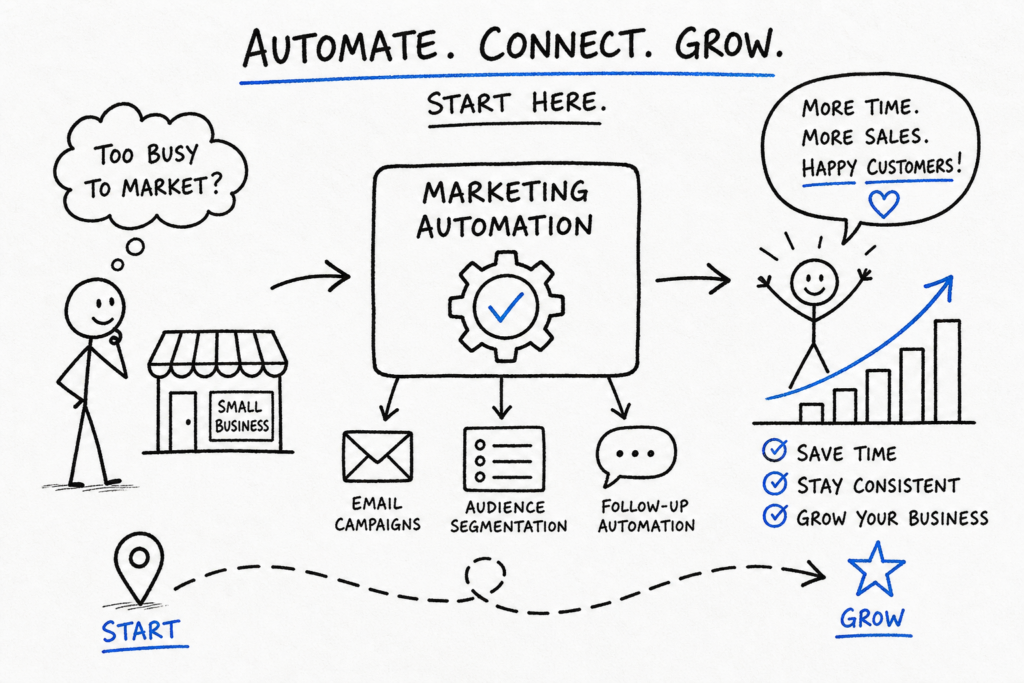
Marketing automation for Small Businesses:
Start Here
“That lead was probably worth $2,000 minimum. Maybe $8,000. Gone. Not because you’re bad at your job. Not because your price was wrong. Just because you were busy doing your job, and nobody was minding the pipeline while you worked. That’s the exact problem marketing automation for small businesses, specifically the kind of service-based business that runs on relationships and referrals, was built to solve.
The good news: you don’t need a tech team, a $50,000 budget, or a marketing degree to fix it. Some business owners build it themselves using marketing automation tools for small businesses that start at $0 per month. Others, like clients who work with CH Web Media, get the whole system pre-built and running before they ever log in. This article covers both paths honestly so you can choose the one that actually fits your situation.
What marketing automation actually does (and what it doesn't)
Compare that to the alternative: tracking leads in a spreadsheet, relying on sticky notes and memory, manually checking who you followed up with last week. The system works 24/7 across email, SMS, and CRM tasks without you touching a single thing. When you’re on a job site at 9 PM, the automation is still sending the right message to the right person at the right time.
Here’s what automation doesn’t do, because people get confused about this: it doesn’t replace the human conversation. It replaces the logistics around that conversation. The follow-up email you keep forgetting to send, the confirmation text that slips through the cracks, the nurture sequence that keeps your name in front of someone who wasn’t ready last month but might be this month. Automation handles all of that so you can show up to actual conversations fully focused on closing deals and delivering great work.
Marketing automation small business quick wins: the workflows to build first
1. The welcome sequence: capture intent before it fades When someone fills out your contact form or opts into your list, their interest is at its absolute peak. They just raised their hand. A welcome email sequence is the automated response that capitalizes on that moment before it cools. According to Omnisend’s email marketing benchmarks, welcome sequences consistently outperform standard campaigns by 300, 800% in first-year ROI, which makes sense, since you’re reaching someone at maximum receptiveness. For a service business, a simple four-email sequence covering your introduction, a few client results, answers to common objections, and a clear next step can be built in under two hours on most platforms. For more data on typical opens and engagement for first-contact emails, see these welcome email performance statistics.
2. Lead nurturing: staying visible without being annoying Most service-based leads aren’t ready to book the moment they find you. According to research published by Marketing Sherpa and echoed across Salesforce’s State of Sales reports, warm inbound leads typically need between 5 and 12 touchpoints before converting, with the average across all lead types sitting closer to 8. A simple nurture sequence of 4, 6 emails spread over two to three weeks, covering common questions, client results, and a low-friction call-to-action, keeps your business visible without requiring you to manually reach out every few days. When the prospect finally decides they’re ready, your name is the one they remember because you never went quiet. For more targeted tactics aimed at home service businesses, check out 7 Lead Generation Strategies Every Home Service Contractor Needs, CH Web Media.
3. Appointment reminders: the automation with the fastest paybackThis one often surprises people. Automated appointment reminders can dramatically cut no-show rates, industry data from scheduling platforms like Acuity and Calendly consistently point to reductions of 40, 50% or more, and for home service businesses and consultants, a single no-show might represent $300 to $1,500 in lost time and revenue. Set up a simple reminder sequence (24 hours before, then 2 hours before) and you’ve potentially recovered thousands of dollars per month from a workflow that takes less than an afternoon to build. If you want a full playbook for turning inquiries into booked appointments, see How to Build a Booking Strategy That Fills Your Calendar, CH Web Media.
How email sequences and lead nurturing work together
These two mechanics sound similar but serve different phases of the relationship. A welcome sequence is reactive: someone took action and you’re responding immediately. Lead nurturing is proactive: you’re building trust with someone who isn’t ready yet, staying relevant across weeks or months until they are. Understanding the distinction is the foundation of effective email automation for small businesses.
Here’s what an effective email sequence actually looks like in practice. Take a roofing company running a four-email sequence after a website form fill. Email 1 confirms the inquiry and sets expectations. Email 2 shows before-and-after project photos with a brief story. Email 3 answers the questions homeowners always ask before hiring a roofer. Email 4 creates natural urgency with a limited scheduling window. None of these emails sound like a robot wrote them. They read like a knowledgeable, helpful business that knows exactly what their customers are thinking. Platforms like ActiveCampaign and Brevo let you build these sequences with drag-and-drop visual editors, no coding required. If you’re worried about the time it takes to learn a platform, read more about the ActiveCampaign learning curve.
The mistake most small business owners make is treating follow-up as chasing. Call once, leave a voicemail, maybe send a text, then give up after day three. Nurture automation runs in the background instead, sending value-first content that earns trust over time rather than demanding attention. By the time that prospect is ready to buy, your name is already associated with competence and helpfulness. That’s not an accident. That’s the system working.
CRM automation for SMBs: the piece that makes it all connect
When a lead clicks a link in your email, books a call, and then calls your office directly, a disconnected setup treats those as three separate events with no relationship between them. A CRM integration ties every touchpoint to a single contact record, so you always know exactly where each lead stands and what they’ve already seen. HubSpot’s free CRM syncs natively with its email automation. ActiveCampaign has a built-in CRM with visual pipeline stages. Brevo added CRM functionality directly to its email platform.
For service businesses specifically, the integrations that matter most are contact tagging when a lead takes a specific action (clicking a link, filling out a form, visiting a pricing page), pipeline stage updates when someone books or cancels, and automated task creation for follow-up calls after key triggers fire. When the CRM and the email system share the same data, the whole operation behaves like one coherent machine instead of a collection of disconnected parts. These marketing workflows for SMBs are what separate businesses that close consistently from those that rely on memory and luck.
Affordable marketing automation for small businesses: tools and when to delegate
• HubSpot free tier: A strong all-in-one starting point. Includes CRM, email automation, and landing pages at no cost, with an upgrade path to around $20/month for more features. Native Gmail and Shopify integrations make it straightforward to connect your existing tools. The learning curve is steeper than the others, especially when you get into full automation builds, but the free tier covers substantial ground for a business just getting started.
• Brevo: A solid choice for high-volume email on a budget. Starts at $18/month with unlimited contacts on the free plan and a pay-per-send pricing model. It includes SMS and live chat alongside email, and the interface is straightforward enough that non-technical users can build their first automation workflow in an afternoon.
• ActiveCampaign: The deepest email automation available at the small business price point. Starts at $49/month and comes with 950+ prebuilt automation recipes, a built-in CRM with pipeline stages, and over 350 integrations. According to ActiveCampaign’s own published customer data, the majority of small business users report measurable ROI within six months of getting the system running.
Here’s the honest part of the conversation: building a full CRM and automation setup takes time. A basic welcome sequence might take an afternoon. A complete system with lead nurturing, appointment reminders, CRM pipelines, and integrated follow-up can take anywhere from one week to several months, depending on how complex your business processes are. For business owners already stretched across service delivery, sales, and operations, that time cost is real.
CH Web Media’s Local Reach 360 system solves this directly. Instead of selecting tools, connecting integrations, and writing sequences from scratch, clients get an automation stack that’s already running: CRM synced, email sequences active, and AI-powered follow-up firing on every new lead the moment it arrives. No technical setup required on their end. When automation is built into a fully managed system, the business owner focuses entirely on closing deals and delivering great work, not debugging workflows at 11 PM. If you want a deeper comparison of choosing a managed solution versus doing it yourself, read Done For You System vs DIY Marketing: Which Wins?.
Neither path is wrong. One costs time. One costs investment. Both get you to the same destination: a pipeline that moves on its own while you’re busy running your business.
Your action checklist to get started this week
- Pick one automation to build first: welcome sequence, lead nurture, or appointment reminder. Not all three. One.
- Sign up for a free trial of HubSpot or Brevo and build one workflow this week using their prebuilt templates.
- After 30 days, compare your open rate, reply rate, and booked appointments against your pre-automation baseline. That gap is your ROI.
The bottom line on marketing automation for small businesses
If you’re willing to invest 5, 10 hours upfront, the tools in this article will get you there for under $50 per month. If you’d rather skip the setup entirely and have a full system running inside a done-for-you marketing engine, that’s exactly what CH Web Media builds for service businesses through the Local Reach 360 platform. Either way, the goal is the same: no more leads going quiet because you couldn’t get to them fast enough.
The next person who fills out your contact form deserves a response in five minutes, not three days. Now you have the tools, and the roadmap, to make that happen automatically.

A Complete Done-For-You System to Attract Clients and Scale Your Business.
Get In Touch
6017 Snell Ave #444
San Jose CA, 95125
+1-510-449-4137
karen@chwebmedia.com
Operating Hours
Monday-Saturday: 8:00AM-5:00PM
Passion Project
This isn’t just networking. It’s about sharing your story, finding support, and discovering opportunities with real people who believe in purpose over competition.