
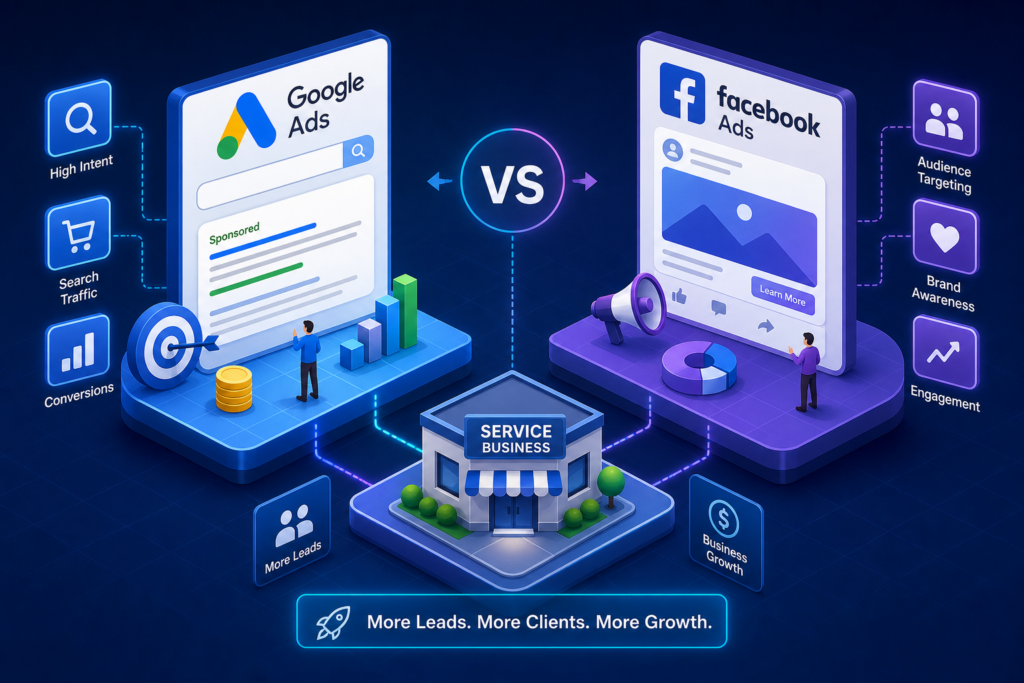
Google Ads vs Facebook Ads for Your Service Business in 2026
The two platforms are not actually competing for the same job. Google and Facebook occupy completely different psychological moments in your buyer’s journey, and treating them as interchangeable options is what leads service business owners to blow $2,000 on the wrong platform and conclude that “ads don’t work.” They work. You just have to match the platform to the moment.
At CH Web Media, running both Google and Meta campaigns for service-based clients is a daily reality. The answer is almost never “just pick one forever.” The better question is which platform matches your service’s buying trigger right now, and when does adding the second one change your results. This article breaks down the mechanics, the real 2026 cost numbers, which service types belong where, and a four-step plan to test your way to an honest answer.
The one difference that changes everything about your ad budget
Google is built for Human A. It is a demand-capture engine. The intent already exists, the urgency is already live, and your ad shows up exactly when someone is actively looking for the solution you provide. Facebook is built for Human B. It is a demand-creation engine. The intent does not exist yet, but the right image, video, or offer can plant the seed of desire that eventually becomes a purchase decision days or weeks later.
This single distinction should drive your platform decision more than any other factor. If your service solves urgent, immediate problems, you need the platform where urgency already exists. If your service requires education, trust-building, or desire creation before anyone would even think to look for you, you need the platform that interrupts and inspires. Everything else, cost, format, and targeting, follows from this.
Google Ads vs Facebook Ads for Your Service Business in 2026
The cost comparison between search ads and social media ads looks deceptively simple on the surface. Facebook wins on raw click price. Google looks expensive by comparison. This framing is almost completely useless for making an actual decision.
Google Search CPCs for local and professional services run high because the inventory is valuable. Home improvement keywords cost $5.21 to $7.85 per click. Legal services run $6.75 to $8.58. Dental sits at $5.62 to $7.85. Those numbers look painful until you factor in what actually happens after the click. Local service conversion rates on Google Search run between 5.5% and 11.5%, which means a $7 click converting at 10% produces a $70 cost per lead. For a roofing job worth $12,000, that math is not a problem. For industry comparisons across verticals, see PPC benchmarks by industry.
Facebook CPCs for most service categories run between $0.80 and $1.50, which looks dramatically cheaper. But conversion rates on Meta average 1.5% to 4%, compared to Google’s 4% to 8% on search. Take a $1.50 click converting at 2%, that produces a $75 cost per lead. You spend almost the same amount and deal with a lead who was scrolling through their feed fifteen minutes ago, not someone who was actively hunting for you. The metric that actually tells you whether you’re making money is cost per qualified lead, not cost per click. A $7 click that converts at 10% is a better deal than a $1.50 click that converts at 2%, because the math produces the same lead cost but not the same lead quality. For a broader look at average conversion rates by channel, this analysis of average conversion rates by channel is a useful reference.
Why cost-per-click comparisons between Google Ads and Facebook Ads mislead most buyers
Which service types belong on Google Ads vs Facebook Ads
Aspiration-driven categories belong on Facebook and Instagram. Med spas, personal training, life coaching, financial planning, home remodeling (the “dream kitchen” version, not the emergency repair version), and real estate are built for social platforms. These services are sold to desire. The buyer doesn’t have an active problem right now; they could be inspired to want something. Facebook’s visual targeting environment, interest signals, and lookalike audiences are designed exactly for this type of purchase psychology. You show the transformation. The desire follows.
Many service businesses sit in both buckets, and this is where the either/or framing really breaks down. Roofing is a perfect example: emergency repairs are a Google problem, but full roof replacements are often a Facebook conversation. Landscaping, home remodeling, consulting, and health and wellness practices all have both urgency-driven buyers and aspiration-driven buyers in the same market. These are not the same people, and treating them the same leaves half your available audience unreachable.
The attribution trap that makes your numbers lie to you
Cross-channel attribution discrepancies of this kind typically run 15% to 40%, based on patterns observed across client accounts, which means every platform is making itself look better than reality. If you’re using platform-reported conversions to decide which channel is “winning,” you are making budget decisions based on each platform’s self-interested accounting. Facebook attribution issues are common and can distort your reporting, for practical context see this piece on Facebook attribution challenges.
The fix is surprisingly simple: establish your CRM as the source of truth. Track every inbound phone call with a unique tracking number, log every form submission, and record every booked appointment with its originating source. When both Google and Facebook leads funnel into the same CRM follow-up system, you can compare cost-per-tracked-lead across platforms without relying on either platform’s self-reported numbers. That is the only fair comparison. If you need a deeper diagnosis of why local service businesses struggle to attract and convert clients, see our analysis of why local service businesses struggle to get clients (and the fix).
A 4-step test plan to validate which channel actually works for your business
- Reading about platforms is useful. Spending real money on one is where you find out what’s actually true for your service and your market. Theory only gets you so far, the data you need exists on the other side of a live campaign. Identify your service’s primary buying trigger. Classify your service as urgency-driven or aspiration/awareness-driven. If customers typically call you when something is broken or wrong, that’s Google territory. If customers need to be shown why they need you before the idea even occurs to them, that’s Facebook territory. Most business owners know this intuitively within thirty seconds of thinking about it.
- Run a focused 30-day test on your matched platform. Budget meaningfully: plan for roughly $900 to $1,500 for a Google Search test or $600 to $900 for a Facebook/Instagram test. If you’re running a tighter budget, expect a longer learning phase and higher variance in early results, factor that into how you read the data. Run tightly targeted campaigns and don’t touch the second platform yet. Mixing both during the test phase makes it impossible to isolate what’s working. One variable at a time.
- Track cost per lead through your CRM, not through platform dashboards. Set up a simple lead-tracking system before you run a single ad. Every form fill, phone call, and booked appointment gets logged with its source. This gives you real lead cost, not the optimistic version each platform reports about itself.
- Scale the winner before expanding to the second channel. Once the first platform is producing leads at an acceptable cost per acquisition, optimize it and increase the budget incrementally. Only then introduce the second platform as a complementary layer. To confirm that adding a second platform genuinely expands your lead volume rather than simply shifting attribution credit, consider running a geo holdout or incrementality test before scaling both channels simultaneously.
Why the strongest service businesses run both platforms and what that looks like
Google handles the bottom of the funnel: buyers who are actively searching right now, with a specific problem and real urgency. Facebook handles the top and middle: future buyers who need to see your business, develop trust over time, and eventually convert when the need arises. A service business running only one platform is only competing for part of its available market, and the part it’s missing doesn’t disappear. It goes to a competitor who figured this out first.
At CH Web Media, the Local Reach 360 system runs Google and Meta campaigns as complementary parts of a single lead-generation engine rather than two separate experiments with separate reporting and separate follow-up pipelines. Google captures active demand. Facebook builds the pipeline of future buyers through retargeting and awareness campaigns. Both channels funnel leads into the same automated CRM follow-up system, so no lead gets lost regardless of which platform triggered the click. The system treats both platforms as one coordinated strategy instead of two competing budgets. If you’re looking to expand your options beyond platform-level execution, we also cover practical lead generation strategies for home service contractors that pair well with an integrated ad approach.
A roofing contractor running Local Reach 360 might capture emergency repair leads through Google Search while simultaneously running Facebook video ads targeting homeowners in high-storm-damage zip codes. Different ads, different audiences, same lead pipeline and follow-up sequence. The result is consistent lead flow across both platforms rather than the spikes and gaps that come from betting everything on a single channel. One platform handles who’s ready to buy right now. The other handles buyers who are still in the awareness stage, typically several weeks to months out, depending on your sales cycle and service category.
The question was never really "which one"
When you look at Google Ads vs Facebook Ads as a genuine strategic question rather than a coin flip, the answer becomes clear: both platforms are valuable, and both have defined jobs to do in a well-built service marketing system. The real question is which one matches your service’s buying trigger today, and how you add the second one intelligently once the first one is working. For a direct comparison of platform strengths and use cases, this overview of Google Ads vs Facebook Ads is a concise companion read.
Start with the platform that matches your service intent. Test it with a real budget. Track leads in your CRM, not on platform dashboards. Scale what works. Then layer in the second platform as a pipeline-building complement, not a replacement. That four-step sequence replaces guesswork with data you can actually act on.
If you want both platforms working together from day one, without the trial-and-error phase or the attribution confusion, that’s exactly what CH Web Media’s Local Reach 360 system is built for. It handles the strategy, setup, and ongoing optimization so you can focus on delivering the service instead of debugging ad campaigns. Explore the Local Reach 360 system to see what a fully integrated Google Ads and Facebook Ads approach looks like for your specific service business. If you’re weighing a managed solution against handling it yourself, our comparison of Done For You System vs DIY Marketing explains the trade-offs clearly.

A Complete Done-For-You System to Attract Clients and Scale Your Business.
Get In Touch
6017 Snell Ave #444
San Jose CA, 95125
+1-510-449-4137
karen@chwebmedia.com
Operating Hours
Monday-Saturday: 8:00AM-5:00PM
Passion Project
This isn’t just networking. It’s about sharing your story, finding support, and discovering opportunities with real people who believe in purpose over competition.